admin

Colchicine-derived anticancer molecules with up to 2000-fold selectivity for cancer cells over normal cells

 A drug discovery research team led by Assoc. Prof. Dr. Tanatorn Khotavivattana from the Department of Chemistry, Faculty of Science, Chulalongkorn University has developed a new class of anticancer molecules by modifying the structure of colchicine, a natural compound known to inhibit cell division by binding to the tubulin protein that forms microtubules inside cells. …

Colchicine-derived anticancer molecules with up to 2000-fold selectivity for cancer cells over normal cells Read More »

Laser-fabricated Electrochemical Sensor for Carbofuran Detection in Agricultural Product

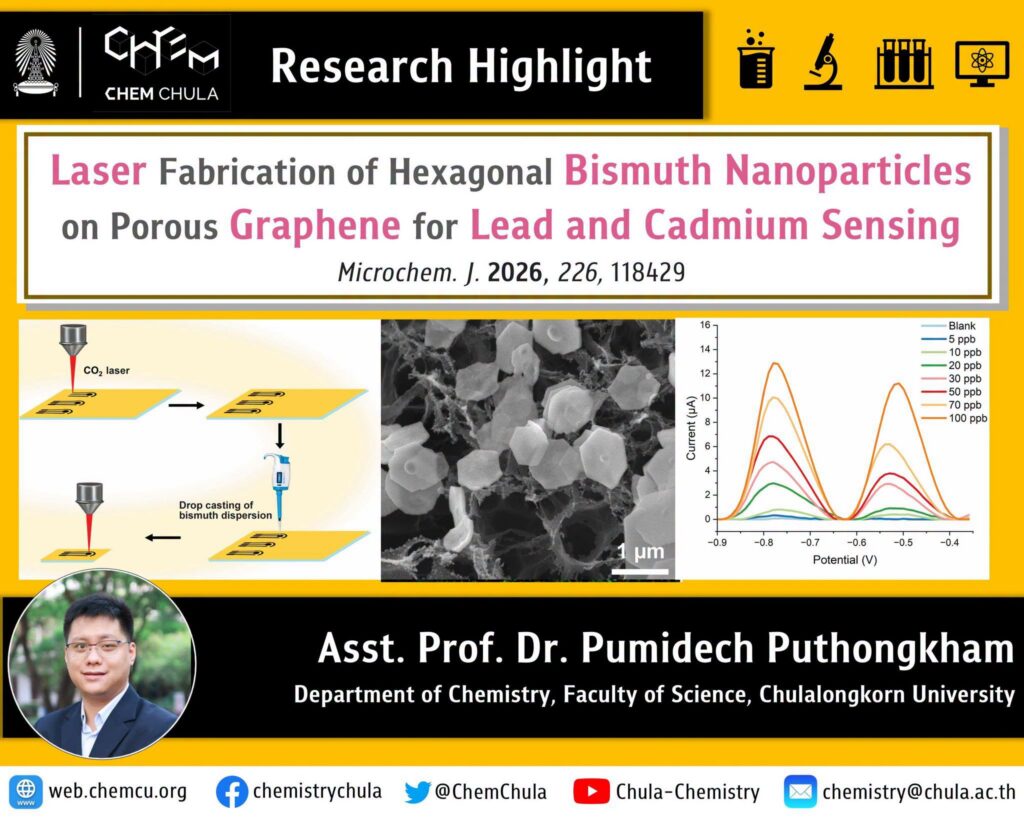
Carbofuran (CBF) is a widely used carbamate pesticide, but improper application can leave harmful residues in food and pose serious health risks. Research group of Assist. Prof. Dr. Pumidech Puthongkham developed a novel electrochemical sensor based on laser-induced graphene (LIG), modified with laser-fabricated carbon quantum dots (CQDs) and electropolymerized poly(β-alanine). The synergistic modification enhanced edge …

Laser-fabricated Electrochemical Sensor for Carbofuran Detection in Agricultural Product Read More »

Hydrogenation of Fatty Acids to Fatty Alcohols over Ni-Mo/Zr-SBA-15

This study reports a sustainable Ni–Mo bimetallic catalyst supported on zirconium-modified SBA-15 for selective hydrogenation of fatty acids to high-value fatty alcohols. The catalyst enables nearly complete conversion of oleic acid to octadecanol under mild conditions and demonstrates excellent stability and recyclability. It offers a greener, cost-effective alternative to noble-metal catalysts for producing bio-renewable chemicals …

Hydrogenation of Fatty Acids to Fatty Alcohols over Ni-Mo/Zr-SBA-15 Read More »

Laser-Induced Graphene Enabled Highly Sensitive Lumpy Skin Disease Detection and Vaccine Validation

The research group of Dr. Supacha Wirojsaengthong and Assist. Prof. Dr. Pumidech Puthongkham collaborated with Prof. Dr. Wanchai Assavalapsakul from the Department of Microbiology, together with several other researchers, to develop a laser-induced graphene (LIG) electrode–based biosensor for both the detection of Lumpy Skin Disease (LSD) and the evaluation of vaccine efficacy. The platform employs …

Laser-Induced Graphene Enabled Highly Sensitive Lumpy Skin Disease Detection and Vaccine Validation Read More »

Fabrication of PDMS-Stabilized porous silver films derived from recovered silver sources as flexible conductive materials

This study presents a simple and efficient method for making flexible conductive materials by forming porous silver films on a PDMS substrate. Silver is first converted into silver acetate through a green acetoxylation process using ethyl acetate, and then thermally decomposed to create a porous silver layer. We tested different silver sources, including pure silver …

Fabrication of PDMS-Stabilized porous silver films derived from recovered silver sources as flexible conductive materials Read More »

Discovery of anti-inflammatory compounds from the stem bark of Garcinia latissima

Garcinia latissima Miq. has been traditionally used by local communities in Indonesia for wound healing and to relieve itching. A phytochemical investigation of the stem bark of G. latissima led to the isolation of tocotrienol and triterpenoid derivatives, including previously undescribed metabolites. Among the isolates, (20R)-eupha-8,25-diene-3β,24ξ-diol suppressed nitric oxide production in LPS-stimulated RAW 264.7 cells …

Discovery of anti-inflammatory compounds from the stem bark of Garcinia latissima Read More »

Artificial three-dimensional skin from fish gelatin-hyaluronic acid porous scaffold

Artificial three-dimensional (3D) skin has been used as an alternative material for toxicity testing, studying skin diseases, and skin tissue engineering. The 3D skin can be fabricated using supporting materials that facilitate cell attachment, promote nutrients and air permeation, and eventually accommodate 3D cellular construction. Herein, fish gelatin-hyaluronic acid porous scaffold were employed as the …

Artificial three-dimensional skin from fish gelatin-hyaluronic acid porous scaffold Read More »

Discovery of New Alpha-Glucosidase Inhibitors from Cannabis Leaves Leading to Structural and Mechanistic Insights

Thailand has permitted the use of Cannabis sativa for medical purposes, creating opportunities for broader research on its potential applications. In this study, 11 new compounds of the cannabinoid and spiroindane classes were identified. These include substances with inhibitory activity against α-Glucosidase, an enzyme associated with diabetes. Molecular docking studies, supported by the research group …

Discovery of New Alpha-Glucosidase Inhibitors from Cannabis Leaves Leading to Structural and Mechanistic Insights Read More »

One class self-organizing maps with Monte Carlo permutation for gemstone classification using Raman spectroscopy

Accurately identifying gemstones is important for authentication and quality control. In this study, we developed an artificial intelligence method that uses self-organizing maps (SOMs) combined with Monte Carlo testing to classify gemstones from their Raman vibrational patterns. The model was optimized for map size and training cycles, and its reliability was evaluated through repeated random …

One class self-organizing maps with Monte Carlo permutation for gemstone classification using Raman spectroscopy Read More »