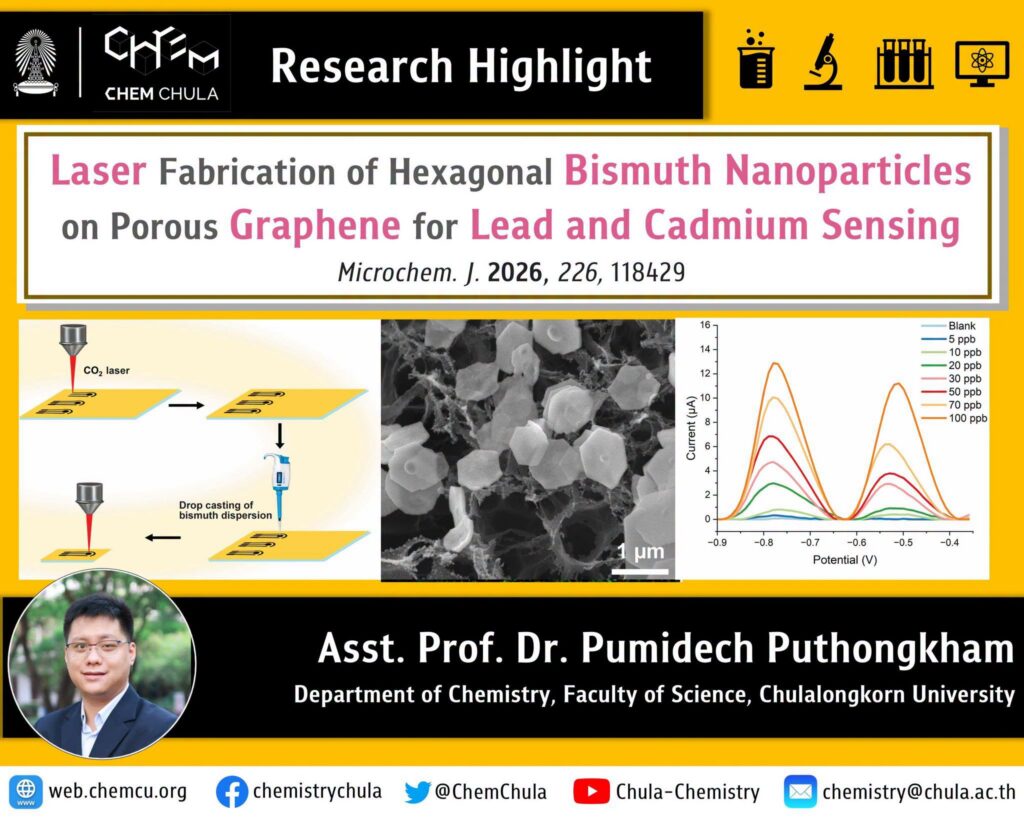
 In this study, a hexagonal bismuth nanoparticle (BiNPs)-modified laser-induced graphene (LIG) electrode was fabricated using a simple CO₂ laser process. The resulting portable sensor enables sensitive detection of toxic heavy metals, including cadmium (Cd²⁺) and lead (Pb²⁺).
 Key findings:
• Simple and scalable fabrication of BiNPs/LIG electrodes by laser writing
• Sensitive detection of Cd²⁺ and Pb²⁺ with a linear range of 5–100 ppb
• Excellent limits of detection of 0.25 ppb for Cd²⁺ and 0.30 ppb for Pb²⁺
• Successful application to wastewater analysis
• Results validated against the standard ICP-OES technique
This work demonstrates the potential of laser-fabricated graphene-based sensors as low-cost, portable analytical tools for environmental monitoring and public health protection. This research was also conducted under the Department of Chemistry’s integrated B.Sc.–M.Sc. program. The project began as an undergraduate Senior Project and was subsequently expanded into a master’s thesis, ultimately leading to a peer-reviewed publication.