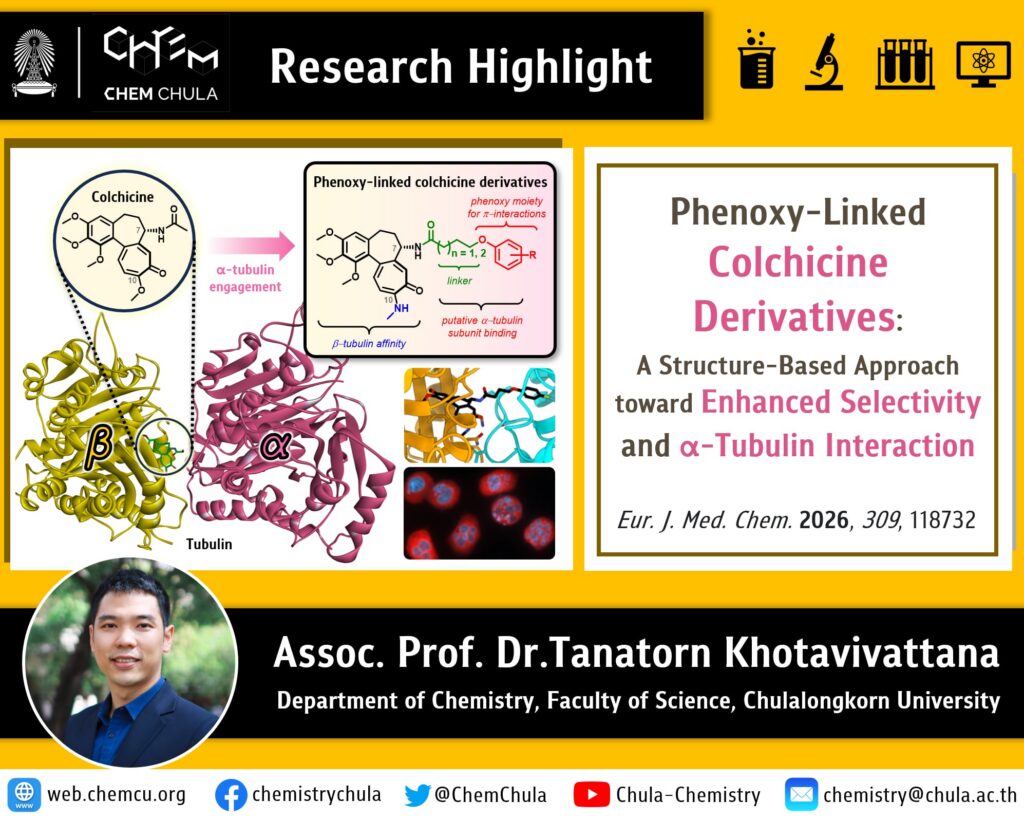
 A drug discovery research team led by Assoc. Prof. Dr. Tanatorn Khotavivattana from the Department of Chemistry, Faculty of Science, Chulalongkorn University has developed a new class of anticancer molecules by modifying the structure of colchicine, a natural compound known to inhibit cell division by binding to the tubulin protein that forms microtubules inside cells.
 The study introduced a molecular design strategy that extends the colchicine scaffold to engage an additional interaction region on tubulin, allowing the molecule to form new interactions near the canonical binding site. This approach was designed to enhance both potency and selectivity toward cancer cells. A total of 22 new derivatives were synthesized and systematically evaluated.
 Several compounds showed remarkably strong anticancer activity in the nanomolar range, with the most active analog displaying an IC₅₀ as low as 0.08 nM, outperforming colchicine and some reference anticancer drugs in the study. Additional analyses using molecular docking and machine learning helped reveal structural features that influence activity and selectivity.