
 The escalating environmental and public health threats posed by pesticide-contaminated water sources and underutilized cellulose-rich waste demand urgent sustainable solutions. This study presents an eco-friendly multiplex colorimetric sensing platform that concurrently addresses these dual challenges by repurposing recycled cellulose derived from recycled office paper. The system integrates a 3D-printed cassette with a semi-interpenetrating polymer network (semi-IPN) hydrogel synthesized from recycled cellulose and carboxymethyl cellulose (CMC). The hydrogel demonstrates exceptional water uptake (616 ± 6 % within 1 min), enhancing rapid analyte diffusion and sensor responsiveness.
 Enzyme-functionalized cellulose nanofibrils (CNFs) immobilized within the hydrogel enable simultaneous, sensitive detection of ethyl-paraoxon and carbaryl, achieving linear detection ranges of 0–1.5 ppm and 0–1.0 ppm, respectively, with high correlation coefficients (R2 > 0.98). The platform exhibits vivid, naked-eye-readable color transitions across a broad pH spectrum (3−12), ensuring versatility in diverse environments. Validation using spiked tap water samples confirmed its practicality for on-site environmental monitoring, with recoveries aligning with regulatory standards. By transforming waste into a functional material, this work advances low-cost, portable analytical devices rooted in circular economy principles, offering a scalable model for sustainable technology development.
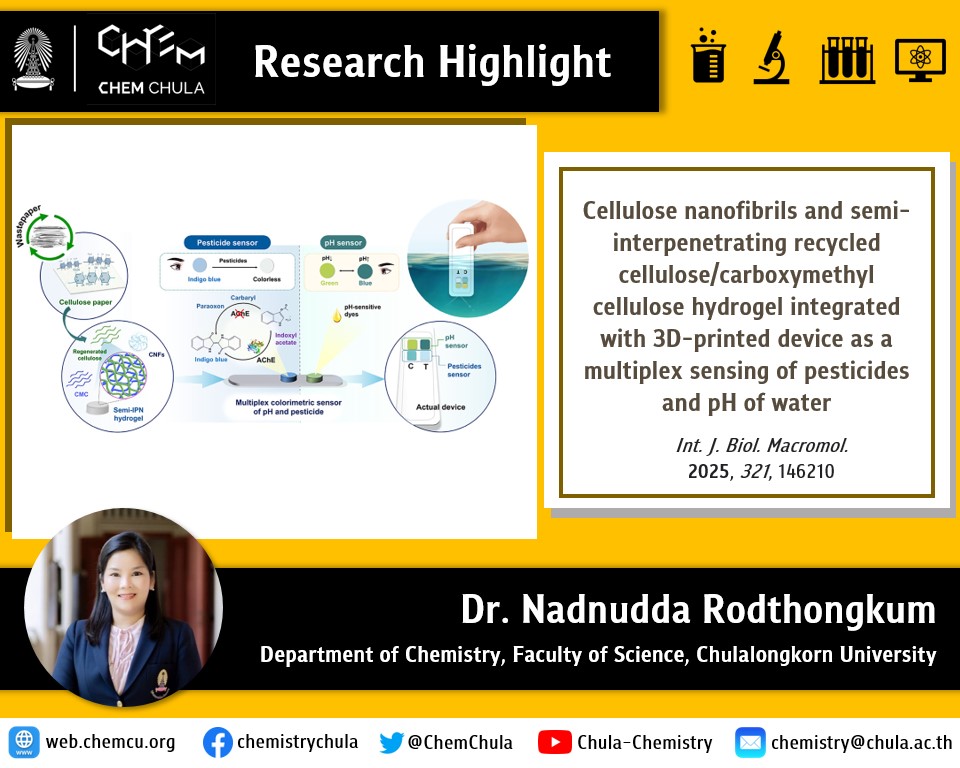
Smart 3D-Printed Hydrogel Sensor: Detecting Pesticides & Water pH with Cellulose Innovation
/ Research highlight / By