
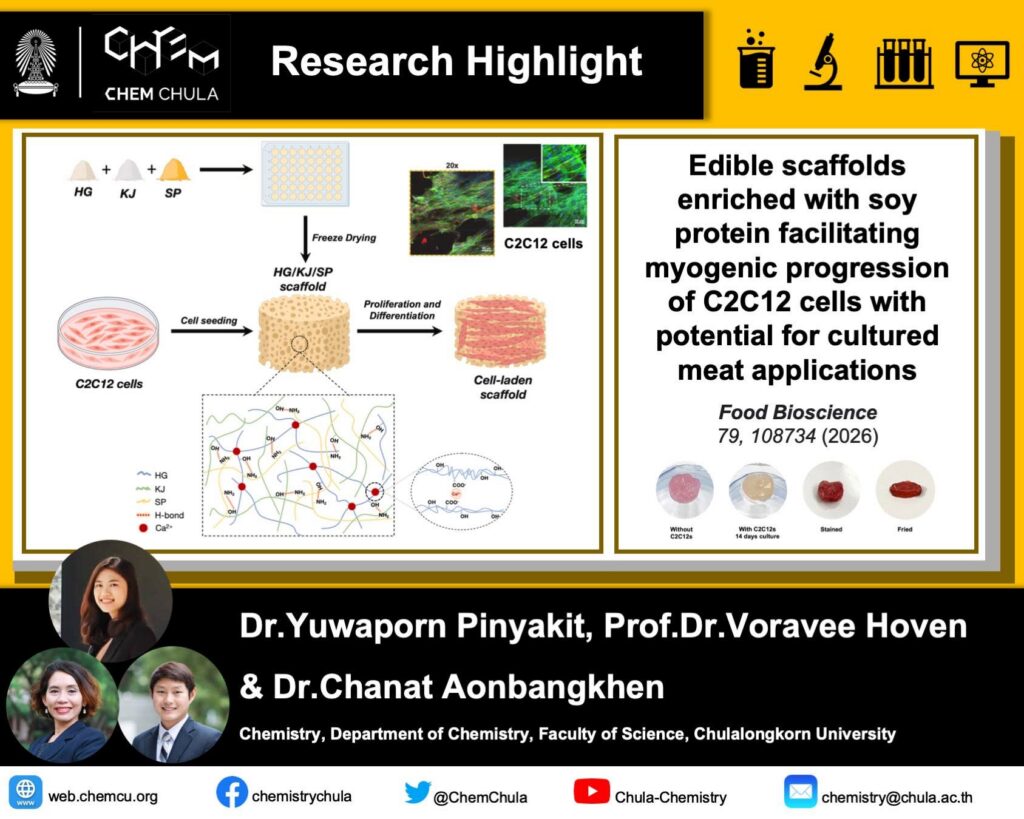
To overcome the problems of livestock farming, cultured meat technologies have been developed. The construction of cultured meat requires edible, biocompatible, and nutrition-rich scaffolds that not only support cell growth but should also align with sustainable, animal-free principles. This research led by the postdoctoral researcher, Ms.Yuwaporn Pinyakit, Prof.Dr.Voravee Hoven, and Dr.Chanat Aonbangkhen, in collaboration with Faculty of Science, Kasetsart University, BIOTEC and MTEC, NSTDA, reports a plant-based composite scaffold composed of high acyl gellan gum (HG), konjac glucomannan (KJ), and soy protein isolate (SP). The composite scaffolds were prepared by freeze-drying, followed by ionic crosslinking, enhancing strength, elasticity, and water retention. These interactions synergistically modulate stiffness, porosity, and swelling behavior, yielding scaffolds with tunable mechanical properties within the optimal range (10–17 kPa) for myogenic cell differentiation. The scaffold exhibited porous morphology with a maximum pore distribution in a diameter range of 50-100 μm. The optimized HG0.33/KJ0.17/ SP0.25 formulation promoted C2C12 myoblast proliferation, differentiation into multinucleated myotubes, and expression of muscle-specific proteins as confirmed by proteomic analysis. Additionally, the scaffold exhibited thermal stability up to 300 ◦ C, suggesting the potential of the developed plant-derived tri-component system with chemically defined, nutritionally enriched, and food-grade approach for cultured meat applications in the future.
- Yuwaporn Pinyakit
- Utumporn Butkatanyoo
- Sucheewin Krobthong
- Bralee Chayasombat
- Yodying Yingchutrakul
- Witchukorn Phuthong
- Voravee P. Hoven
- Chanat Aonbangkhen