
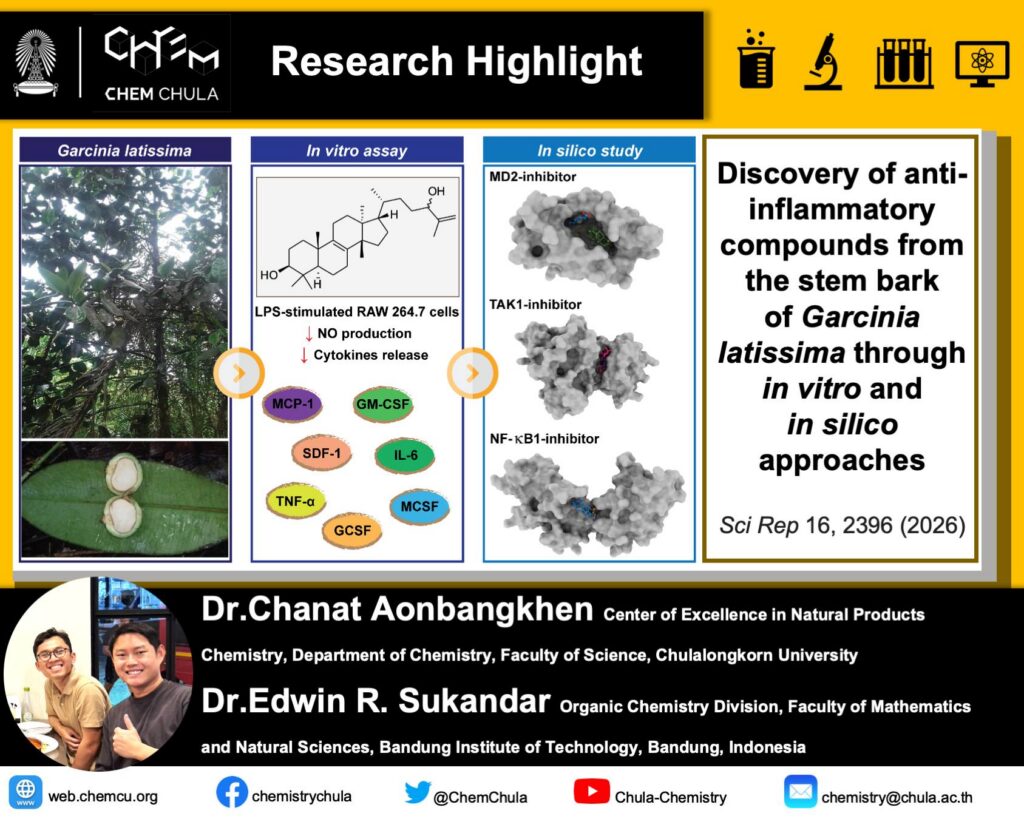
Garcinia latissima Miq. has been traditionally used by local communities in Indonesia for wound healing and to relieve itching. A phytochemical investigation of the stem bark of G. latissima led to the isolation of tocotrienol and triterpenoid derivatives, including previously undescribed metabolites. Among the isolates, (20R)-eupha-8,25-diene-3β,24ξ-diol suppressed nitric oxide production in LPS-stimulated RAW 264.7 cells by more than 60% at concentrations of 10 and 50 µM, without significant cytotoxicity. It reduced the release of several inflammatory mediators, particularly MCP-1, as determined by an antibody array. ELISA confirmed a significant decrease in the MCP-1 levels, following the treatment with the compound. Molecular docking and molecular dynamics simulations suggested a strong binding affinity of the compound to MD2, TAK1, and NF-κB1, key proteins in the TLR-4 signaling pathway, with predicted affinities higher than those of reference ligands. ADMET analysis further suggested favorable drug-like properties, including high predicted oral bioavailability and minimal toxicity. These findings suggested that our newly described compound has promising anti-inflammatory potential, warranting further experimental studies to elucidate its mechanism of action and to validate its effects in additional inflammation-related bioassays.
- Edwin R. Sukandar
- Nitchakan Darai
- Jaruwan Chatwichien
- Sutthida Wongsuwan
- Sutin Kaennakam
- Thitiporn Pattarakankul
- Retno Purbowati
- Taslim Ersam
- Kowit Hengphasatporn
- Yasuteru Shigeta
- Patipark Kueanjinda
- Tanapat Palaga
- Santi Tip-pyang
- Warinthorn Chavasiri
- Thanyada Rungrotmongkol
- Chanat Aonbangkhen