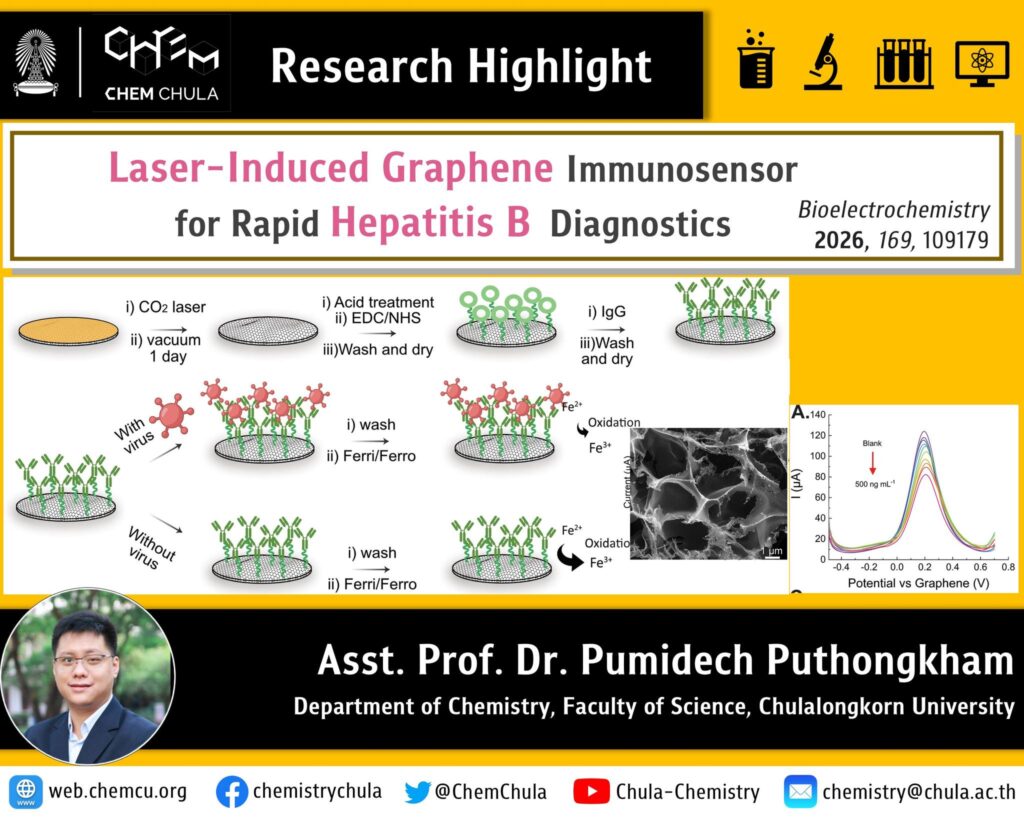
 Dr. Pumidech Puthongkham’s research group has been pioneered the application of Laser-Induced Graphene (LIG) in electrochemical biosensors in our department! We’ve just unveiled a high-performance immunosensor for Hepatitis B surface antigen (HBsAg) detection.
Why it’s a Breakthrough: Ultra-Sensitive & Fast: Functionalizing more carboxyl group on LIG electrode enhanced HBV antibody immobilization, yielding an incredibly low limit of detection (LOD) of 0.04 pg/mL, covering a 5 orders-of-magnitude linear range.
 LIG Technology: We used a simple CO2 laser process to fabricate the robust graphene sensor, making it perfect for cost-effective, point-of-care (POC) diagnostics.
 Durable: Exhibits outstanding selectivity and stability, lasting over 30 days.