Machine Learning–Driven Approach for Anticancer Drug Discovery
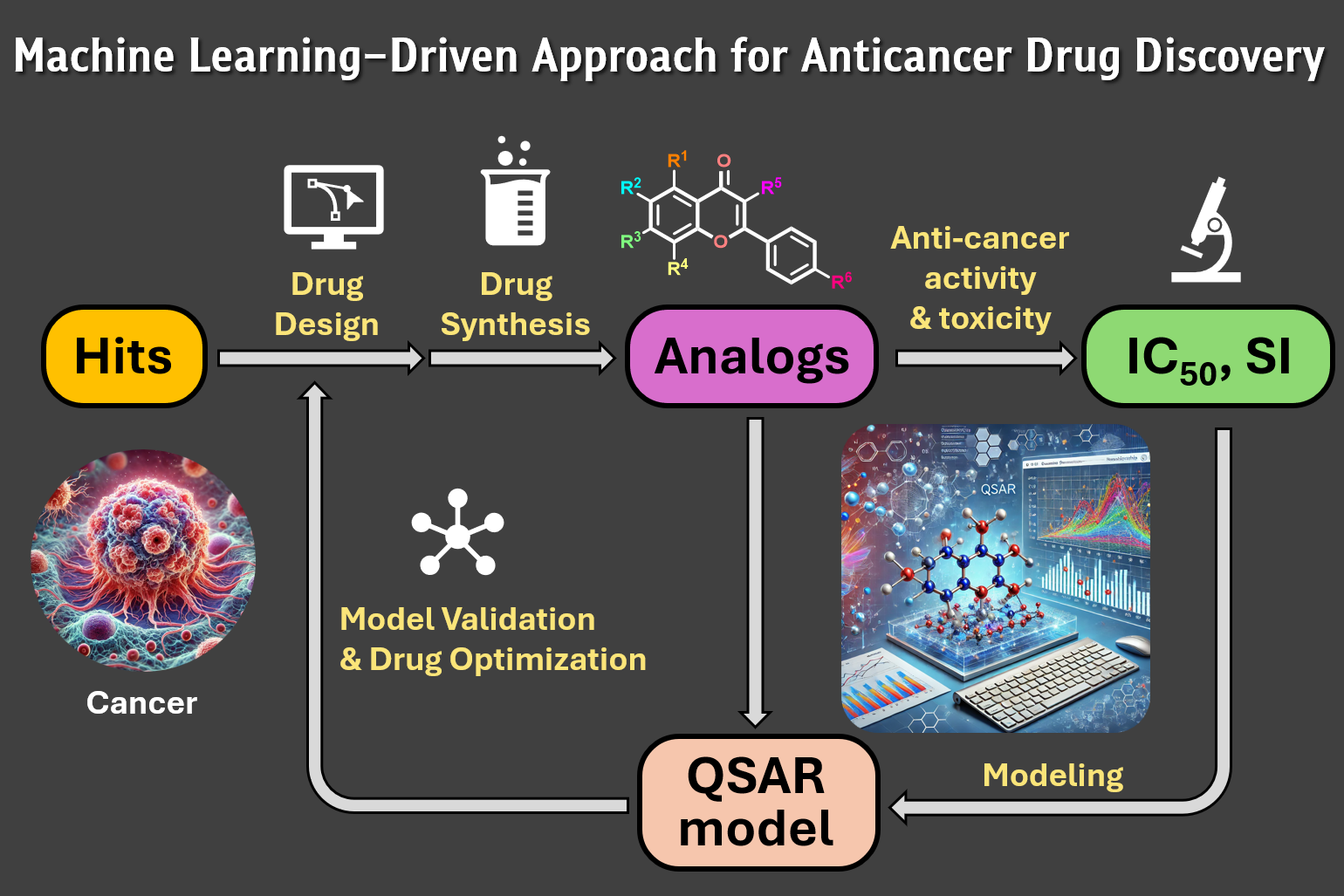
The integration of high-throughput screening (HTS), synthetic chemistry, and machine learning (ML) provides a systematic and iterative approach to anticancer drug discovery. Promising hits from HTS of natural products and small molecules form the basis for developing an in-house library of analogs through innovative organic synthesis. This library is utilized to construct machine-learning QSAR models that predict and rank compounds based on potency, selectivity, and pharmacokinetics. Insights from these models feed back into the design–synthesis loop, enabling the creation of increasingly potent and selective anticancer agents. By combining data-driven insights with experimental validation, this approach aims to deliver novel, targeted therapies to address the critical need for innovative cancer treatments.
Salt-Free CatAnionic Vesicular Nanoreactor from Dithiocarbamate: Michael Addition of Nitroolefins in Aqueous Vesicle System

The salt-free CatAnionic vesicle was previously generated by mixing cationic and anionic amphiphiles, and removing the salt that occurred as a side product from the mixture. A new strategy to produce the salt-free CatAnionic vesicle of N,N-dialkylamonium N,N dialkyldithiocarbamate (AmDTC) through a one-step condensation between secondary amine and carbon disulfide is demonstrated. Both cationic (dialkylamonium) and anionic (dithiocarbamate) amphiphiles were generated concurrently during the condensation. The AmDTC dispersed in water, resulting in the spontaneous formation of salt-free CatAnionic vesicles. Among several AmDTCs, the N,N-didodecylamonium N,N-didodecyldithiocarbamate (AmDTC-C12C12) showed high stability and applied as a vesicular nanoreactor for the Michael addition in water. Michael addition between nitroolefins and 1,3-dicarbonyl compounds yielded the desired twenty-three Michael adducts, with yields ranging from 65% to 92%. It is hypothesized that the AmDTC-C12C12 serves as a vesicular nanoreactor and plays a role in catalysis at the dithiocarbamate group. Preparative-scale and one-pot Michael addition by in situ generation of AmDTC-C12C12 vesicle afforded the Michael adducts also in good yields. The AmDTC-C12C12 vesicular nanoreactor was applied for the synthesis of (±)-baclofen with 54% yields over three steps. Reusability of the AmDTC-C12C12 was demonstrated and allowed the reuse up to seven cycles. The chemical recycling was demonstrated by converting AmDTC-C12C12 to N,N-didodecylammonium chloride by simple acidification.
Keywords: CatAnionic Vesicle, Nanoreactor, Michael Addition
Dr. Tatchamapan Yoskamtorn
Insights into the Structures and Dynamics of Functional Materials for Renewable Energy, Catalysis, and Sensing
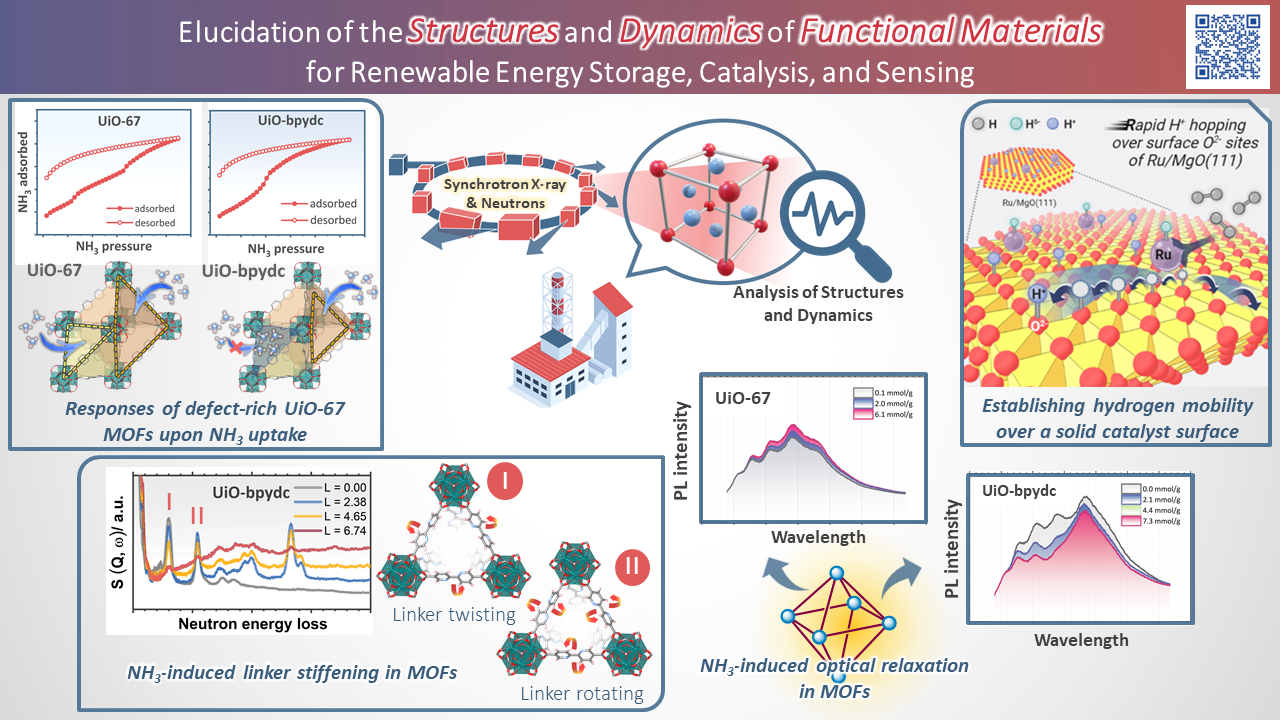
In order to design next-generation nanomaterials for renewable energy storage and catalysis, our research focuses on thorough investigations of the structures and dynamics of functional materials such as metal-organic frameworks (MOFs), zeolites, and supported metal nanoparticles, with unprecedented guest-induced properties. We have a particular focus on using a multi-disciplinary approach to gain new insights into the structure of materials and their dynamic behaviours in the solid state. The utilisation of in-situ diffraction and spectroscopy, combined with theoretical calculations, is our core methodology for achieving such detailed analyses not only under realistic conditions but also at a molecular level. For instance, the combined use of synchrotron X-ray diffraction (SXRD), neutron powder diffraction (NPD), and quasielastic neutron scattering (QENS), can yield important insights into the structures and dynamics of materials and surface species, while inelastic neutron scattering (INS), Infrared and Raman spectroscopy can give information on host-guest interactions and reaction chemistry. A comprehensive analysis of guest-induced structural changes, surface adsorbates, and reaction mechanisms involved has been reported in high-quality journals. Our growing understanding will lead to better design of novel functional materials, which hold significant relevance for both fundamental science and innovative technology. In the future, we aim to expand our in-situ and integrated methods to design and develop effective catalytic systems that can be used for the chemical recycling of waste plastic.
Keywords: functional materials, heterogeneous catalysis, biomass upgrading, energy storage and conversion, chemical recycling
Dr. Wid Mekseriwattana
Microwave-assisted synthesis of water-soluble iron oxide nanocubes for cancer magnetic hyperthermia therapy
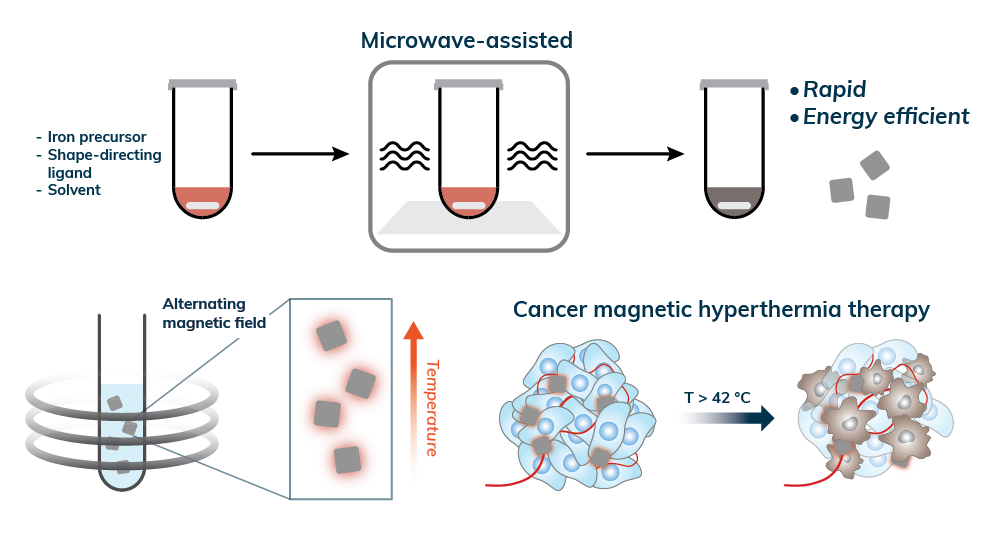
Iron oxide nanocubes (IONCs) are among the most efficient magneto-responsive heating nanomaterials for magnetic hyperthermia therapy (MHT). Conventional synthesis for controlling of size and shape is based on non-hydrolytic route, which are not environmentally friendly and not suitable for biomedical applications. In this work, a new method for synthesizing IONCs with hydrophilic surfaces will be developed, based on polyol synthesis. The used of shape-directing ligands will be varied to control the size and cubic morphology of the IONCs. Microwave synthesis system will be used as a green and energetically efficient heating technique to maximize the reaction efficiency in terms of reaction time and conversion yield. The resulting IONCs will be tested based on their magneto-responsive heating properties, and their toxicity will be tested in a 2D in vitro cell culture model.
Keywords: Iron oxide nanocubes, microwave chemistry, magnetic hyperthermia